A First Walk Around a New Garden Without Missing Its Flow
A first walk around a new garden can feel confusing. Follow its entrances, paths, plant groupings, and pauses to understand how the space works.
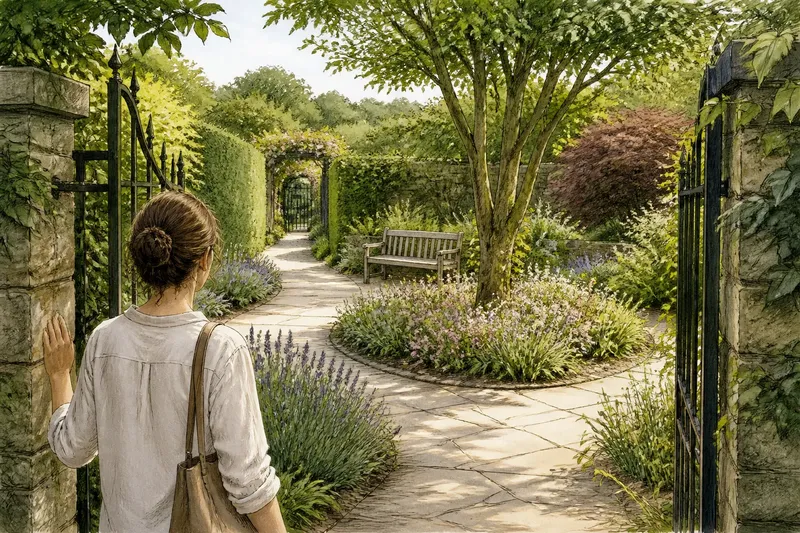
The most common mistake on a first walk around a new garden is trying to identify every plant before noticing where the garden leads. That can cost you the sense of direction that makes its layout legible: a path becomes a strip of paving, a bench becomes an object, and the garden’s sequence gets lost among names. A first walk around a new garden works better as a slow reading of how the space invites you to move.
You do not need a plant list or a route planned in advance. Start at the entrance, follow the paths that are already there, and notice where the garden opens, narrows, or gives you a reason to stop. If you want to remember details, use a small notebook or your phone’s notes app for brief observations, not a running inventory.
Start at the entrance instead of choosing a destination
Pause where you first enter. Look back toward the approach, then into the garden. Notice which direction seems easiest to take and what draws your eye: a bright opening, a tree canopy, a gate, or a view beyond the garden’s edge. That first impression gives you a starting point for understanding how the space introduces itself.
Then take a few ordinary steps in. Do you arrive in a broad open area, or does a hedge or wall guide you along a narrow way? Is there room to turn without stepping into a bed? These small transitions reveal whether the entrance is meant to gather people, pass them through, or offer a first view before the route bends out of sight.
For a useful note, describe the experience rather than guessing at the designer’s intention. “The gate opens toward a shaded path” is more useful than “This must be a meditation garden.” Keep interpretations tentative until the rest of the route supports them.
When the paths feel unclear, follow the easy line
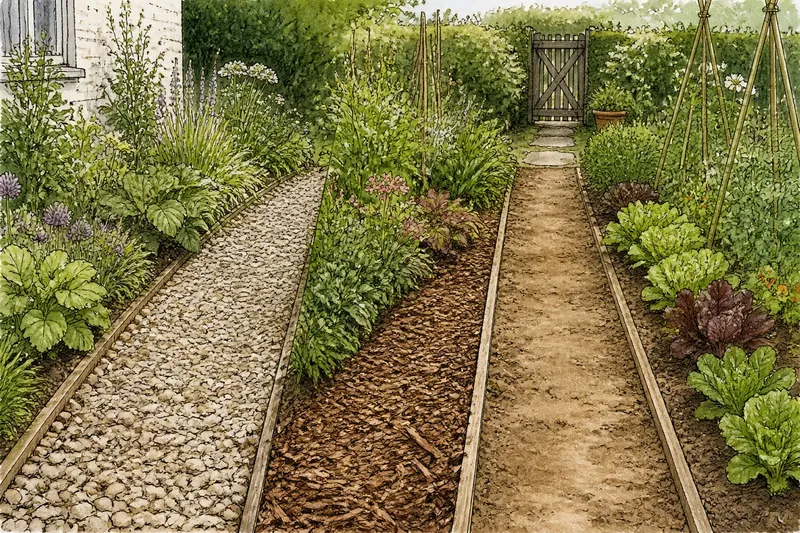
In an unfamiliar garden, several routes may appear equally plausible. One may be a formal path; another may be a mown strip or stepping stones that lead between planted areas. Rather than cutting across a bed to reach a feature, follow the surface that clearly accommodates walking and see where it goes. That keeps the visit considerate and helps you understand the garden as it is arranged.
Notice how a path behaves. Does it continue in one direction, bend behind planting, split at a junction, or end at a gate? A curve may conceal the next view; a straight path may make a distant feature visible from the entrance. Changes in paving or width can signal a shift from a route for passing through to an area meant for lingering.
If you reach a junction and cannot tell which branch matters, take the one that feels like the natural continuation, then look back at the split. The view from the opposite direction can explain why the paths meet there. If a route is closed or marked for staff, treat that boundary as part of the garden’s practical layout rather than searching for a way around it.
When plantings look like a jumble, read the groups first
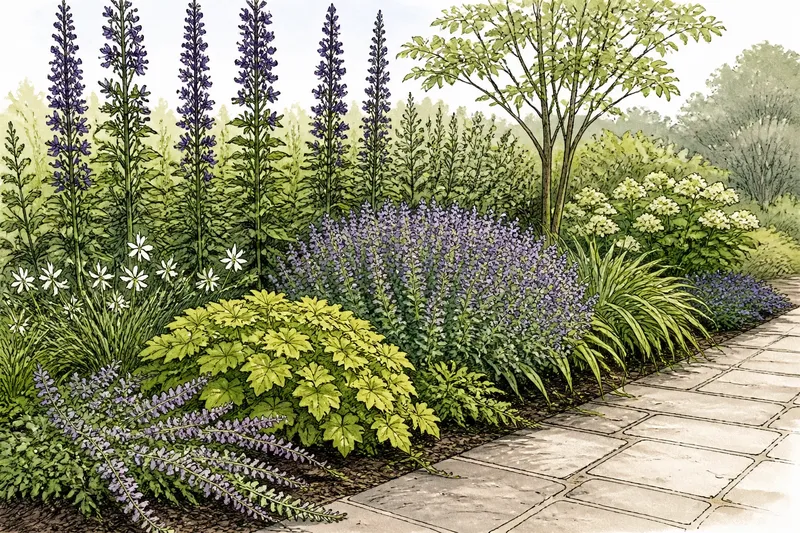
A mixed planting can seem difficult to understand when you look at each plant separately. Step back and notice the larger shapes: a low border along a path, a cluster around a tree, a repeated drift, or a dense screen between two areas. Look for repetition in color, height, texture, or spacing. Those patterns often explain how the planting gives a space its edge or guides a visitor’s attention.
Compare the planting with what it borders. A soft mass of grasses may make a path feel less formal; a clipped hedge may create a clear boundary; a gap in shrubs may frame a view into another section. You do not need to decide whether a planting is successful. Ask what it lets you see, what it hides, and how close it brings you to the route.
Imagine you enter a courtyard with a central tree, a narrow paved path along one side, and a loose band of flowers around the trunk. Instead of trying to name the flowers, you might notice that the path stays clear while the planting softens the tree’s base. From the far side, the flowers may also screen part of the entrance, so the courtyard feels more enclosed than it did on arrival.
When you pass a good stopping place, take the pause
Some garden features make more sense from a standstill. A bench, low wall, broad step, or shady patch can offer a place to see the paths and plantings from a different angle. Sit or pause only where it is welcome, and take in the near view as well as the distant one. You may notice a framed view, a change in enclosure, or a second route that was easy to miss while walking.
A pause does not have to be at a formal seat. If a path widens or a sheltered corner gives you room to stand without blocking others, stop briefly and look back along the route. Ask whether the garden feels different from this point: more open, quieter, more private, or connected to a neighboring area. Record the change in feeling alongside what you can see.
When one lap feels incomplete, change your viewpoint
A first route can leave you with an uneven picture. A screen of shrubs may conceal a side path; a feature may look disconnected until viewed from farther away. Before assuming the layout is confusing, turn around at a safe, open point and revisit part of the route in the opposite direction. A garden designed to unfold gradually may reveal its connections only as you approach from another side.
Keep the second pass focused. Choose one question raised by the first walk, such as where a path leads or whether a planting defines an edge, and look for the answer without retracing every detail. If the garden is busy, avoid lingering in narrow passages or blocking a viewpoint. A brief look from an open area may be enough.
What should you notice on a first garden visit?
Should you identify the plants as you walk?
Not at first. Notice the shape and role of a planting before checking a label, if one is available. Names can add useful detail later, but they do not explain how the group relates to the path or the view.
What if a path seems to lead nowhere?
Look for a place where it changes direction, meets another route, or opens toward a feature. If it ends at a closed gate or a clear boundary, do not try to pass through; return to the last junction and follow an open path.
How can you remember the layout afterward?
Write a simple sequence such as “gate, shaded bend, open lawn, bench.” Add one detail about a view or planting at each point. This rough route will usually help you recall the garden more clearly than a long list of plant names.
Is it better to walk the whole garden in one visit?
No. A shorter route with a few clear observations can tell you more than rushing through every section. Leave a branch for another visit if it is crowded, closed, or simply less inviting that day.
Leave with a route you can picture
Before leaving, take a moment near the entrance to recall the sequence you followed. Name the turning points, the strongest view, and the place where you paused. This is a practical way to hold on to the garden’s flow without turning your visit into a survey. A first walk around a new garden need not explain everything; it should give you a route you can recognize and a reason to notice something different next time.
If you return, begin from a different entrance or revisit one junction from the opposite direction. The same path can reveal another relationship between planting, shelter, and view when you approach it differently. Let that new perspective guide the next walk rather than trying to complete a mental inventory.