The Kitchen Garden Before the Seed Packet
Kitchen garden seed saving carries practical memory forward. Learn how to record a seed’s source, assess inherited advice, and choose what to grow again.
The common mistake in telling the kitchen garden’s history is to treat the seed packet as the start of organized planting. That overlooks how gardeners in different places kept seed, shared advice, and made planting choices from season to season. These practices varied; there was no single system used by every household.
In a kitchen garden, a saved seed could be tied to a plant someone valued, while advice might come from a relative or neighbor. The useful question was not simply what to keep, but why it suited that garden and household. That distinction still helps gardeners assess inherited seed and planting habits without treating a personal story as a universal rule.
Saved seed carried a choice, not a complete record
Keeping seed meant deciding that a plant was worth preserving. A gardener might value its flavor, its usefulness in the kitchen, or how it grew in a particular spot. Leaving selected plants to produce seed also meant giving them a different role from plants harvested for food.
Seed alone could not explain the choice. Its name, source, and the reason it was kept might be remembered by the person who saved it, but not by someone receiving it later. Treat an unknown detail as unknown. Do not turn a family name or informal label into a claim about a variety’s history.
Use a seasonal routine to make decisions
A notebook and pencil are enough to capture decisions that matter. Keep seed in a suitable envelope or container and follow crop-specific handling guidance; collection and storage needs differ among crops. For each observation below, note what you saw and use the result to choose an action.
- Seed identity: Check the name and known source. If both are clear, keep them together on the label; if either is uncertain, mark it as uncertain and ask the giver before treating the name as confirmed.
- Planting advice: Check what the giver said about timing or placement. If it fits the crop guidance and your conditions, consider trying it; if it conflicts or the conditions differ, check reliable crop-specific guidance before acting.
- Growing area: Check where you planted the crop and what you observed there. If the plants appeared suited to that spot, consider using it again; if they struggled or the site has changed, choose a different suitable area or seek local growing advice.
- Use in the kitchen: Check whether the harvest suited your household’s needs. If it did, consider growing it again; if it did not, choose another crop or keep only a small amount while you reassess.
- Seed selection: Check which plants you left to produce seed and why. If the reason still matters, keep the seed clearly labeled; if the reason is unknown, record that gap and avoid presenting the choice as a proven growing advantage.
- Next-season decision: Check the notes against your current space, schedule, and crop needs. If the seed and advice still fit, plan to use them; if not, set them aside, ask the source for clarification, or choose a better-suited option.
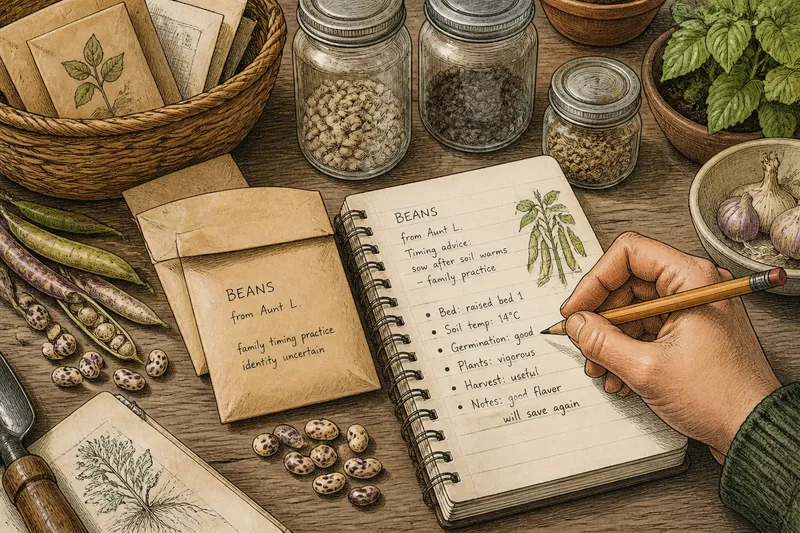
Say you receive an envelope labeled “beans” from your aunt, who says her family sowed them after the soil warmed. You write down “beans,” your aunt’s name, and that the timing advice is family practice, not a confirmed variety or rule. You check crop-specific guidance, choose a suitable bed, and note how the plants grow and whether the harvest is useful. If the bed and crop suit each other, you can consider using the seed again; if not, your record points to a different bed or a need to clarify the seed’s identity. The tradeoff is clear: you preserve the advice while leaving room to revise it.
Ask about the source before adopting the advice
When someone shares seed, ask what name they use, who saved it, and what they remember about growing it. Ask whether a planting suggestion is based on their own observation, a family routine, or something they heard from someone else. Those distinctions help you judge how closely their conditions match yours.
Advice can also be learned by watching someone prepare a bed, arrange plants, or choose what to harvest. If you pass the practice on, explain its purpose when you know it. “We leave this plant for seed” describes an action; adding that the household wants seed for another planting explains the choice without claiming the method suits every garden.
Keep the purpose of a planting habit
An inherited routine may connect a garden task to a family gathering, a shared bed, or a familiar place near the kitchen. Keep the habit as a starting point, then check whether its planting method fits the crop and current growing conditions. A meaningful routine need not require copying every detail.
Imagine a family traditionally sowing a crop when relatives prepare a shared bed. A new household uses a different bed and checks whether its conditions suit that crop before sowing. The family can keep the shared workday while adapting the planting choice if the new site is unsuitable.
How should you judge inherited seed advice?
What can I do with seed that has an uncertain name?
Keep the name exactly as the giver uses it and mark it as uncertain. Ask about its source, then consult crop-specific guidance before relying on any identification or growing instructions.
What should I write down when someone shares seed?
Record the name used, the person or household who supplied it, and the advice they gave. Note what is firsthand, what is family practice, and what remains unclear.
Can I change an inherited planting habit?
Yes. Keep the purpose if it matters to you, then adjust the method to fit the crop and your garden. If you are unsure about a crop’s needs, consult a reliable local gardening resource.
How do I decide whether to grow saved seed again?
Review its identity, growing conditions, and usefulness to your household. If important details are uncertain or the seed did not suit your garden, seek clarification or choose another option rather than repeating the decision automatically.
Let each season clarify what you know
Kitchen garden knowledge could travel through seed, conversation, and repeated work, but its details depended on the people and conditions involved. Keep that history distinct from what you observe in your own garden. The phrase kitchen garden seed saving is most useful when it includes both the source of the seed and the reason for keeping it.
Before planting again, read the label and your notes side by side. If they leave a decision unresolved, ask the person who shared the seed or consult crop-specific guidance before sowing. That small check helps you carry useful knowledge forward without mistaking uncertainty for fact.